|
|
Le
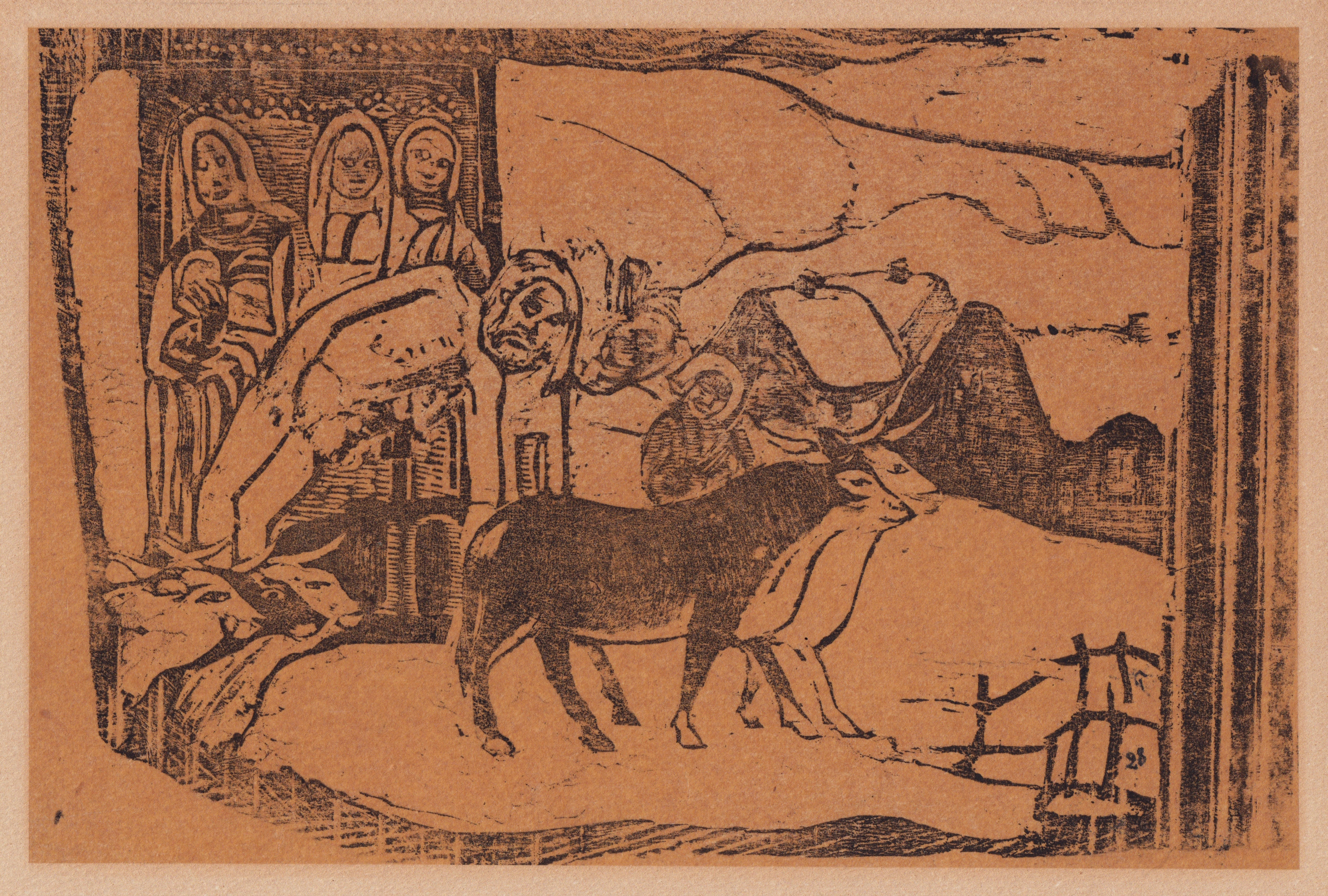
Calvaire Breton
The Wayside Shrine in Brittany
Guérin 68; Mongan,
Kornfeld & Joachim 50
woodcut, 1898-89, on
tissue-thin Japon
paper, finely laid down on medium-heavy cream wove paper, with a narrow
margin on the left and slightly trimmed into the subject elsewhere
(Paul Gauguin most often cut
his impressions down closely, sometimes significantly into the
composition*)
signed by the artist in black ink with a capital "P" lower right, and numbered "28",
exceptionally with uniform ochre toning to the sheet; the print itself
is very fine condition, with no defects visible aside from a fleck of
black ink lower left
S.
150x227mm.
(The original woodblock, held in the Bibliothèque
Nationale de France, measures 16.5 × 26.5mm overall; see Note below)
Provenance: formerly in the collection of the art historian, Lawrence Saphire (not listed among the 17 impressions that Mongan,
Kornfeld & Joachim have identified)

|
Gauguin
returned to France
from Tahiti for the last time in July 1893, spending two years, mostly
between
Paris and Brittany, with a final stay in Pont Aven during
1894. Back in Tahiti the following year, he undertook his last
printmaking project in 1896-99, mixing Tahitian and Breton themes,
often in the same series.
Le Calvaire Breton
is usually dated between
1896 and 1889, as one of his late woodblock series, well after his return to
Tahiti, though it incorporates the Deposition of Christ from the 15th
century Calvary of Nizon, near Pont Aven*, which Gauguin painted in
the picture of the same title, Le Calvaire Breton or Christ Vert in 1889 (Wildenstein 328 , now in the Musées Royaux
des Beaux Arts de Belgique, below, left).
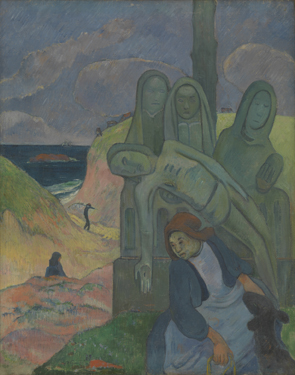
In place of the rugged Breton dunescape in the picture, Gauguin added a hilly winter village background to the print, with a hamlet in the background and teams of oxen moving across the front of the scene, to the right, toward what would appear to be an enclosure.
We
know that Gauguin intended to use this print as the leftmost panel of a
triptych of woodcuts, with the Char à Boeufs set in the middle and Misères Humaines (below, right) to the right. (See
the cogent discussion by Richard Brettell of this series in
the Gauguin
exhibition
catalogue, RMN, Paris 1989, pp. 417-421, as well as their theoretical
assembly reproduced in the Art Institute of Chicago study of Gauguin's
woodcuts.**)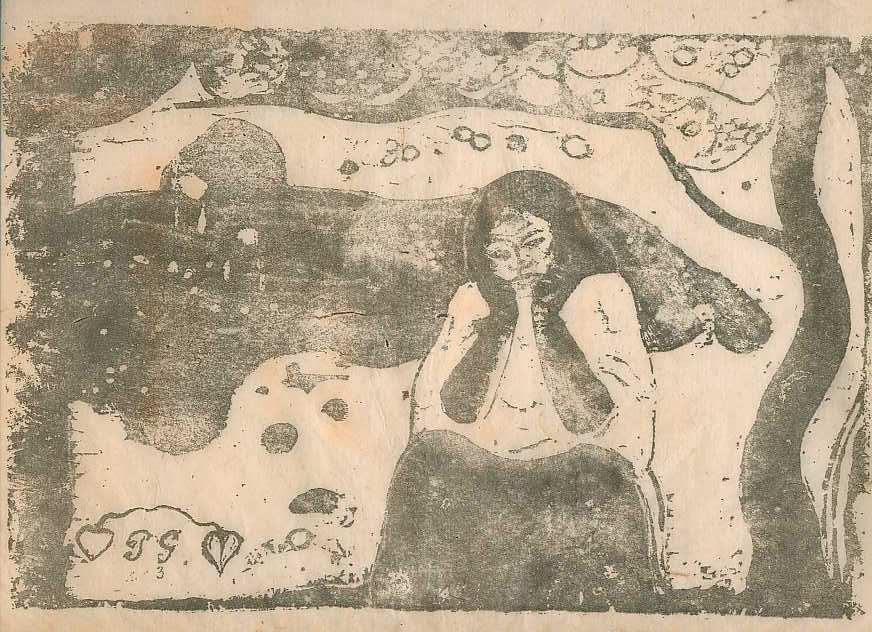
In this
context, the Calvaire is
scenographically compatible with the Char
à Boeufs,
as it has the same snow-capped houses with snow-bound hills in the
background, and the same hieratically aligned oxen. With the palissade to the far right, abutting that of the Char à Boeufs, it may be seen that if each sheet
were trimmed to whatever width, they would fit well.
(The Art Institute of Chicago's Technical Study
also includes a demonstration that the two wood blocks were probably
hewn from the same plank of indigenous wood, which reinforces Gauguin's
intent.)
The subject of
Gauguin's scenography however, is not simply
a
wintry village scene. It relates more especially to well-known
Breton folklore: it is said that the
animals, on Christmas Eve, steadfastly keep watch (it is said that only toads and humans
then sleep!),
and they speak together in human tongue, with the keen ability to foresee the future.***
Given his mystical
interest in such traditions, both in Brittany and Tahiti, Gauguin was certainly aware of this belief, which would have influenced his
work, as well as the Breton scenography here present.
Gauguin's
concern with religious themes in any case ran through a good part of
his life, and was summed up in the unpublished work, L'Esprit Moderne et le Catholicisme
(now in the Saint Louis Art Museum, see
https://www.slam.org/collection/objects/18302/?ocaid=modern-thought-and-catholicism-gauguin#mode/2up)
a synthetist approach to the religions of the world that he completed
in the Marquesas in 1902, and which here is evident in the cortege of
oxen, moving from the Calvary to the Nativity.
It should be
added too that our impression is a good example of Gauguin's
exploration of using color in his late woodcut printmaking. Gauguin's
coloring is rather varied, most often in the
application of earthen
colors,
sometimes in zones or a thinned, uniform toning, elsewhere
as a watercolor wash; these various techniques have been studied in
depth by a curatorial team
from
the Art
Institute of Chicago.**** Our impression is marked by a flat color field of ochre, what the AIC call "transfer coloring".
|
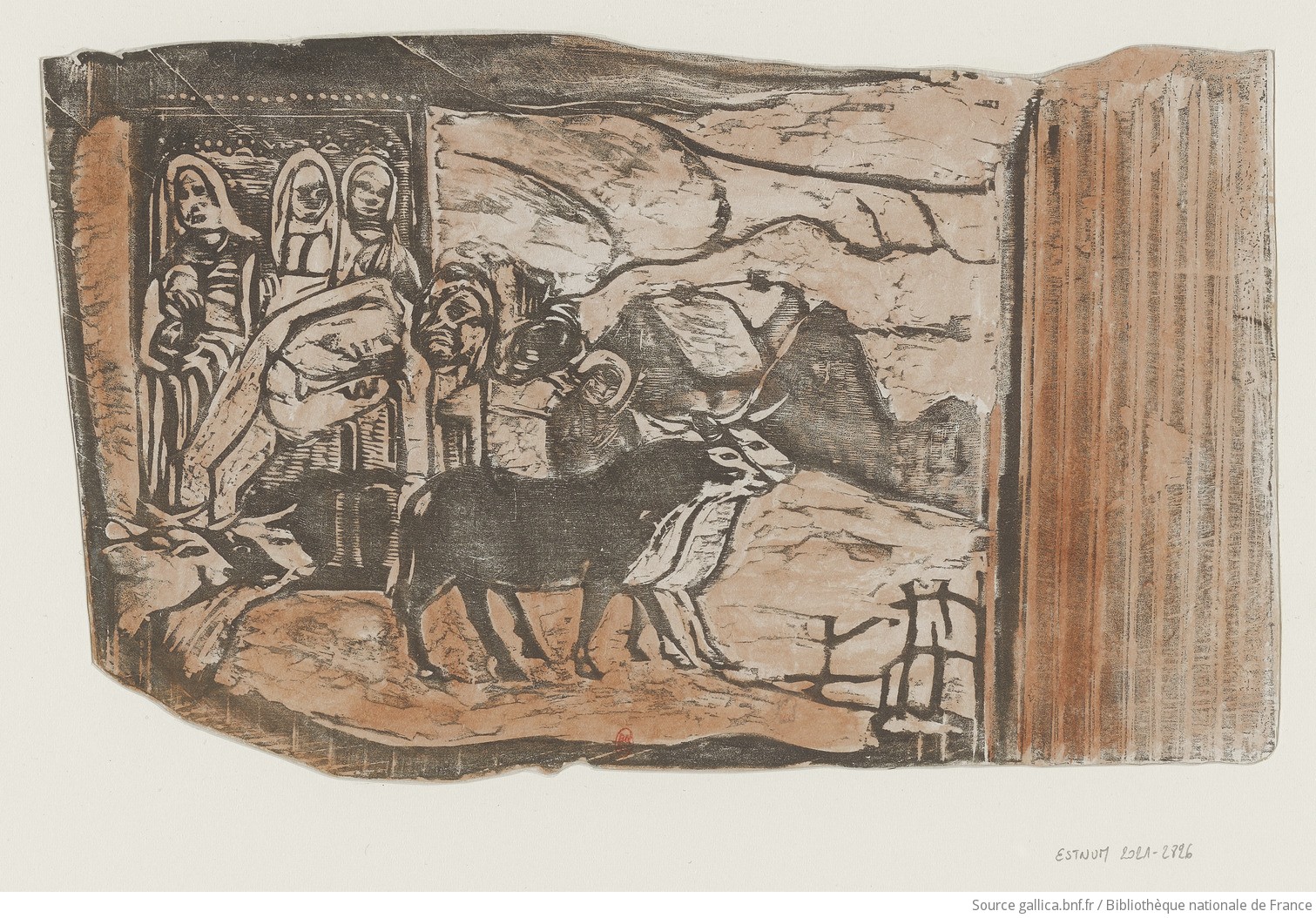
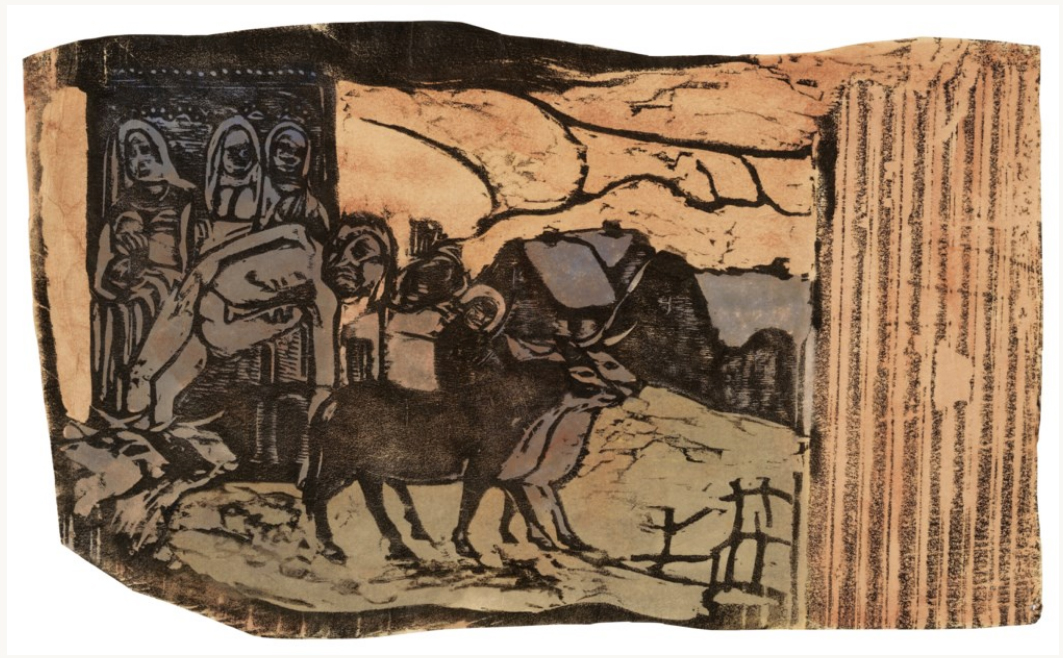
There are two other impressions known which have additional coloring, using an ochre ground, which we have both examined:
- the impression in the Bibliothèque nationale (right,
see https://gallica.bnf.fr/ark:/12148/btv1b108404175?rk=21459;2) shows
a more irregularly applied ochre ground, much heavier in the immediate
foreground, the far left barn gateway, and the vertical planked
structure on the far right.
|
|
- another
impression (right,
originally from the Gustave Fayet collection) is heightened with
addtional touches of grayish-blue and yellow, notably adding a sombre
note to the Calvary scene, which accords more specifically with the
intent of the original
picture: https://onlineonly.christies.com/s/prints-multiples/paul-gauguin-1848-1903-67/192306
|
|
In conclusion,
Gauguin's experiments in coloring the print sought to instill a stark
visual impression of the cataclysmic gloaming that accompanied the
deposition from the cross,
projected into Breton imagery resonant with local folklore in a
panorama sweeping across from the crucifixion to worldly human misery
of all kinds...
_________________
* See https://monumentum.fr/monument-historique/pa00090287/pont-aven-calvaire
** See
https://publications.artic.edu/gauguin/reader/141096/section/140419,
and especially the analysis by Harriet Stratis:
"Gauguin took
the thick, irregular pieces of wood he found in Tahiti, including more
rectilinear planks, and crudely cut them down laterally to reduce their
thickness. Taking into consideration that the indigenous wood was not
commercially manufactured into regularly sized blocks, the unusual,
irregular contours and grain in the wood used by Gauguin provide
topographical reference points that allow them to be matched and
paired. Five such pairs were identified during the course of this
study. These include Wayside Shrine in Brittany and The Ox
Cart" https://publications.artic.edu/gauguin/reader/141096/section/140412/p-140412-17
*** See
François-Marie Luzel, Légendes
Chrétiennes de la Basse Bretagne, Paris 1881, pp. 329 et seq. In one of the legends, on
Christmas Eve, a large red ox spoke thus:
- Our Lord is born, my
children, the merciful and almighty God, and he was not born in a
palace or in the house of a rich man of the earth;
he came into the world, like the
last of the unfortunate, in a manger, between an ox and a donkey! Glory
to the Lord!
see also:
https://fr.wikisource.org/wiki/L%C3%A9gendes_chr%C3%A9tiennes_de_la_Basse-Bretagne/Veill%C3%A9e_bretonne
or
-
http://www.tresor-breton.bzh/2019/12/29/les-animaux-se-parlent-en-breton-la-nuit-de-noel/
**** See Daher, Sutherland, Stratis, & Casadio, Paul Gauguin's Noa Noa prints: Multi-analytical characterization of the printmaking techniques and materials, in Microchemical Journal, 2018, 138, pp.348-359.
There is also a
video demonstration of these printing
techniques that the Art Intitute of Chicago has produced, now visible
online here: https://www.youtube.com/watch?v=eoVT2UZ_drs
NOTES
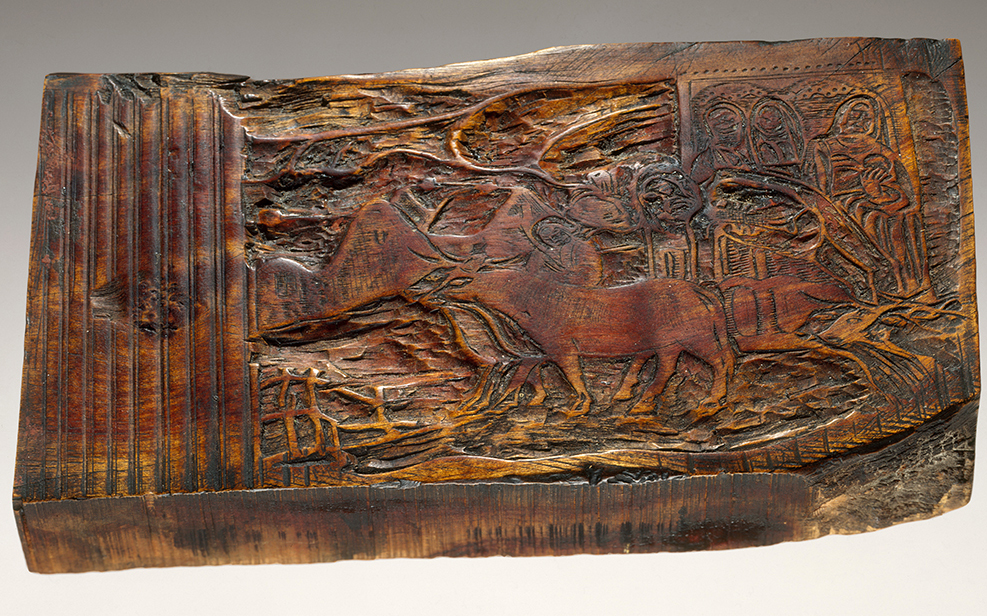
The form of the original wood block (below, right
)
influenced Gauguin's pulling of the impressions, and furthermore, he
also trimmed each quite closely, often well into the composition
itself.
The dimensions of each known proof are thus somewhat variable.
Mongan,
Kornfeld & Joachim
give the dimensions of the early impressions as 161 x250 mm,
again most ofen cut down into the composition.
Cf. the Art Institute of Chicago
impression, from the renowned Guérin collection, for which the dimensions of the trimmed sheet are given as 152 × 227 mm. (https://www.artic.edu/artworks/60634/wayside-shrine-in-brittany-from-the-suite-of-late-wood-block-prints)
See also https://www.nga.gov/collection/art-object-page.38998.html