|
|
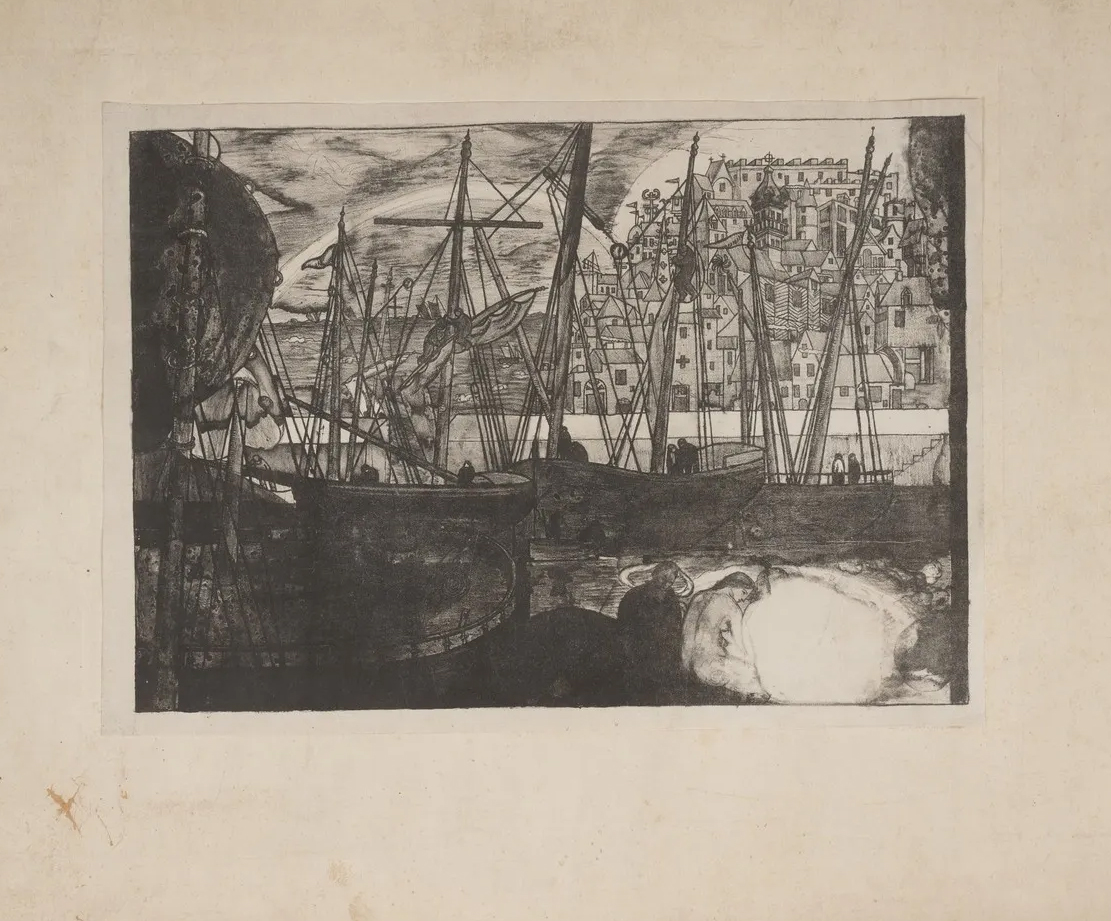
Pêcheurs de Goémons
(Seaweed Fishermen)
Field, Strauss, and
Wagstaff 85
zincograph, printed in
black, circa 1895, on fine
tan
wove paper, mounted onto a
heavier carton with three small points of glue, with small margins, the
sheet trimmed somewhat irregularly, though well away from the borderline, some
overall soiling and a few unobtrusive filiform traces of rubbing in the
image, visible only in raking light,
otherwise in very good
condition
Provenance: a private
Breton collection
P. 202 x 288 mm.
S. 220 x 305 mm.

|
The print's title comes from Field, Strauss, and Wagstaff and relates
to a Breton practice of harvesting seaweed (Fucus and Laminaria, often
called wrack in English),
which had a variety of uses in the late 19th century.
Seguin's intent may however
have been somewhat more complex and the figures in the foreground are
curious: there is apparently the sombre figure of a woman in dark
dress with a traditional coiffe,
next to a young naked woman, seated and bent to the right, who appears
to be embracing a large white bale of what has been considered to be a
sack of the harvested wrack. On closer examination, one may also
discern a male figure leaning left, toward the woman, though only his
head and shoulder still remain visible. Was the plate still in
progress, Seguin seeking to refine the foreground scene? As
there has never been a formal edition of this print, is the work
unfinished? The question remains open...
It should be noted that we
believe the inital state of the plate was marred by several large
discoidal blemishes of what was probably an ink solvent that fixed onto
the plate, notably visible to the left in the two known impressions**
that we have examined (BNF and Josefowitz Collection sale at
Christie's); another appears faintly below the naked woman and a third
within the image at the far right corner. In our impression these
first two have been deftly cleaned from the margin, though the last one
remains visible. It may be hypothesized that the blank white
field of the "bale" was also a effort to revise the composition while
effacing another large solvent blemish misprinting, a trace of which
may be seen down across the male figure in the BNF and Josefwitz
impressions.
In any case, the present
impression is of the utmost rarity, and aside from the two mentioned
here, we have never seen any other, either in museum collections or on
the market.
* The dimensions of
202x288 that are usually given for the zinc plate, though is may have
been larger, as no real platemark is visible, and the misprinting
blemishes visible in the two impressions cited below seem to extend
beyond the borderline of the print.
** See https://gallica.bnf.fr/ark:/12148/btv1b10022925f/f1.item.zoom
and https://onlineonly.christies.com/s/la-collection-sam-josefowitz-dessins-et-gravures-de-lecole-de-pont/armand-seguin-1869-1904-900/198770